Monday, March 8, 2010
December 2, 1982--4 Children
I have had my happy ending. My four darlings have grown up into strong, loving wives and mothers with challenging careers, supportive feminist husbands, and brilliant children. Parents in the trenches often are comforted by how many mistakes I was making.
My kids are 9, 7, 4, 7 months. We had impulsively moved to Bangor, Maine from Manhattan in March 1981; I almost immediately got pregnant. We are snowbound November through April. My husband insisted on heating our 4-bedroom house entirely with our wood stove and six cords of wood. We had a three-sided metal gate attached to the living room wall with carabiners to keep the girls away from the stove. I had never before had to cope with stairs and kids. My ability to write in full sentences has collapsed. I am trying to decide whether we should try to move back to New York. I am very active in the Nuclear Freeze movement. Being a political activist and the mother of 4 isn't working. I remember the good times so vividly and totally forget the hard times. No wonder why younger mothers reject the saccharine advice of older mothers.
I have not edited my journal entry.
I let the kids stay home today because Michelle was hoarse and Emma was hard to rouse. Their being home busy with their projects makes it harder to keep Molly (the baby) safe. Molly has a scratch near her eye, and I don't even know how she got it--perhaps the kitten? Made apple crisp, made bread. No oven timer, so I kept losing track, worried about the stove door being so loose--will it fall off? Reading Lifton-Falk book about nuclear war, will give me nightmares. Kids bickering; baby eating pieces of paper. All my careful preparation for naught, no time to sit down and relax. Molly hardly napped. Papers all over living room floor. Snapped and yelled.
Do I want to go back? Something always make me stop at the brink. Fear of admitting we made a mistake? Or are these growing pains? Half-conscious of my tendency to romanticize my life in New York. I didn't share my political interests. We probably know more people in Bangor who share my interests than we did in New York. I glanced back over my journals. A bracing perspective. Mothering has always been hard. So much for my fantasies about how much better a mother I was in New York. I am so hard on myself. Go to the library and look up book on depression.

Wednesday, July 1, 2009
Presidential Candidates of 2044
The Future


I deliberately chose serious pictures of my then 8-month-old and 5-month-old granddaughters. Read the green shirt. Intellectual self-confidence breeds true. I will be 99 when they can run for president in 2044.
Radical feminist that I was, I was shocked to discover when my first daughter Emma was born in 1973 that motherhood empowered women, made them much stronger and braver. I decided to write a book reconciling intense motherhood and feminism. Twenty -six years later I am trying to gather up writings scattered in untranscribed noteboks, on floppy discs most computers can't read, too many blogs under too many pseudonyms.
During the primary campaign, I was chagrined to discover that I had gifted my 4 daughters with brilliant nonsexist childrearing, but apparently felt it unnecessary to grow young feminists. They often had never heard of authors that had shaped me.
My grandmother was born in 1898. She voted in the first election open to women. At 40 she was a widow, with 7 children, including a two year old. She had lost a daughter and both her parents were dead. My mother had to abandon her journalism dreams and go to secretarial school. Looking back in 1980 at 1939, she wishes she would have become a lawyer, like her dad and two brothers. If she were born 25 years later, I am certain she would have gone into politics. My daughter Jane, who is both a lawyer and a writer, has succeeded where my mother and I faltered.
The book will concentrate on my mom and me, but I will also discuss my grandmother, my daughters (stressing education, career, combining motherhood and career), my niees. I have two granddaughters, 8 months and 5 months; another is due in early September. I also have 2 great nieces. I hope my granddaughters and grandnieces grow up in a family friendly America, but I was sure my daughters would as well. I hope we will have a woman president before they are eligible to run in 2044.
I have an abundant of original source material, including well over a thousand letters my mother wrote to my soldier father from November 1942 to February 1946, when he first met his 7-month-old daughter. My mother lived in Uniondale, 3 miles away from my home in Baldwin from 1947 to 2002. She was a community leader and the mainstay (close to assistant pastor) of her church, St. Martha's. She went to nearby colleges, Nassau Community and Hofstra. She taught American History at Uniondale High School from 1969 to 1980.
I decided to make St. Martha's my church home, at least for the time being. I went to the weekday mass this morning and talked to five people who knew my mother well. I am now in the Uniondale Library, looking at their strong local history collection. I have all the documents from my mother's hard drive, with long lists of phone numbers. At least five of her closest friends are still alive, including two who have known her since they were 13.
My uncle, another history teacher, has a huge archive of family letters, including the ones my grandmother wrote to them when he was pursuing graduate study at Notre Dame. He moved from Long Island to the finger lakes when he retired. We are spending our summer vacation four miles away from where he lives. I teased him if he leaves me his archives, I will write his biography. He never ever throws anything out.
I have never thrown out the journal I kept from the time I dropped out of Columbia Law School after two weeks in 1971 through my pregnancy in 1972-73. Most of it is about feminism, wrestling with the possibilities of combining ambition and mothering.
My daughters never experienced discrimination through their brilliant college and graduate school careers. It is only now, when three of them are new mothers, that they realize their daughters do not live in a post-feminist world.
Friday, April 3, 2009
Transforming Joy of Birth and Breastfeeding

Seconds after Birth of Oldest Daughter,1973

Late April, 1973

Home Birth, 1982
Monday, February 16, 2009
Worm Turns; Younger Sister Learns to Scheme
I don't want to masquerade as an all-wise mother and grandma. No mother of 4 daughters ever masters sibling rivalry. In the last 3 years, since 3 daughers became mothers, I feel like I am back in adolescence and all the rules have changed.
My daughters find my journals hysterically funny.
Fall 176--Emma is 3 1/2; Michelle is 17 months
When Emma came home from nursery school, she wanted me to read Green Eggs and Ham. She settled on my lap in the small black chair, and I began to read. Michelle immediately came over protesting, tried to climb into the chair. I assumed she wanted to listen to the story, so I asked Emma to move to the couch, so we all could fit. But then Michelle started grabbing the book, bringing me her books to read.
My daughters find my journals hysterically funny.
Fall 176--Emma is 3 1/2; Michelle is 17 months
When Emma came home from nursery school, she wanted me to read Green Eggs and Ham. She settled on my lap in the small black chair, and I began to read. Michelle immediately came over protesting, tried to climb into the chair. I assumed she wanted to listen to the story, so I asked Emma to move to the couch, so we all could fit. But then Michelle started grabbing the book, bringing me her books to read.
I discouraged her, feeling she had had my exclusive attention for 4 hours; now it was Emma's turn. My friend Terry offered to read to Michelle, but she struggled down from her lap 2 or 3 times. I finished reading Green Eggs and Ham. Terry started to read to Emma and Erin, so I could read to Michelle. Michelle got down from my lap and tried to grab the book away from Terry. When that failed, she tried bribery--3 books, her blanket, a slip, her rabbit skin. Erin wanted the rabbit skin, but every time she took it away from Michelle, she protested and only stopped when Terry took it back from Erin.
Finally Michelle used one of the cardboard blocks to climb on the ottoman; from there she lunged for the big black chair where Terry was sitting with Emma and Erin. She didn't quite make it and had to be rescued, but she had achieved her purpose--the reading stopped. I've noticed that she often starts fussing if someone picks up Emma, reads to her, pays her exclusive attention in any way, shape, or form
I'm glad to see such self-assertion on her part, even though I feel pulled in two directions now with both of them clamoring for exclusive attention. It frees me from being Michelle's defender. More and more I can let them learn to handle their disputes by themselves. I know Emma's worst won't really hurt Michelle, and Michelle's protests more than enough to warn me if any mayhem is actually occurring. Once or twice lately I've rushed in ready to scold Emma, when Michelle's protests had absolutely nothing to do with her. Emma's being away at school mornings seems to have encouraged Michelle to increase her demands. If she could get rid of Anne in the mornings, why not all day?
After describing this revealing incident, I earnestly tried to establish rules for myself . As the oldest of six, I probably overidentified with Emma. I read this to her recently, when her son was Michelle's age, and we collapsed in helpless laughter. How earnest and intellectual I was trying to be, pretending I could objectively stay above the fray. Some of my advice is excellent; too bad I wasn't able to follow it. I had obviously read too many parenting books and taken too many contradictory parenting classes.Finally Michelle used one of the cardboard blocks to climb on the ottoman; from there she lunged for the big black chair where Terry was sitting with Emma and Erin. She didn't quite make it and had to be rescued, but she had achieved her purpose--the reading stopped. I've noticed that she often starts fussing if someone picks up Emma, reads to her, pays her exclusive attention in any way, shape, or form
I'm glad to see such self-assertion on her part, even though I feel pulled in two directions now with both of them clamoring for exclusive attention. It frees me from being Michelle's defender. More and more I can let them learn to handle their disputes by themselves. I know Emma's worst won't really hurt Michelle, and Michelle's protests more than enough to warn me if any mayhem is actually occurring. Once or twice lately I've rushed in ready to scold Emma, when Michelle's protests had absolutely nothing to do with her. Emma's being away at school mornings seems to have encouraged Michelle to increase her demands. If she could get rid of Anne in the mornings, why not all day?
- When in doubt about what to do, don't interfere.
- If I am concerned that one of them could really get hurt, always intervene. In practical terms, that means always being within interfering distance when they are both playing on the slide, on the climbing structure, or on the terrace.
- When other people are around who would tend to think very badly of Emma if she made Michelle cry, intervene.
- Protect Emma from Michelle. She should have time alone in her room to paint, to build with blocks, when Michelle is not constantly at her back, intent to destroy what she has just made. When Emma complains that Michelle is bothering her, respond and help her out. It is completely unreasonable to expect Emma to handle Michelle's interference by herself. I find it hard enough to distract single-minded Michelle.
- Encourage Anne to find solutions to the problem herself. "I'm sorry Michelle keeps knocking down your blocks. Do you have any idea how we can stop her from doing it." Poor Anne. No wonder, she told me, a few years later, "Don't give me any of that active listening crap."
- Try to spend one hour special time with Anne after dinner. Now that she will be away from me three hours a day in nursery school, this is particularly important.
- Make a firm rule about no hitting with things. The thing used as a weapon gets put in the closet until the next day. "Blocks are for building, not for hitting Michelle. You can have it back tomorrow."
- When I find it necessary to intervene, use actions not words. No screaming, no getting angry. Separate them physically. Then, and only then, try to help Anne. "I think you are trying to say something to Michelle. Talk it. You can talk; you don't have to hit. I know how you feel, but I can't let you hurt Michelle. It makes her feel like hitting you."
- When one of them is likely to continue hurting, use physical restraint. Take her to another room to calm down, telling her she can come back when she can play without hurting.
- Don't get angry. If I can't intervene without getting angry, don't bother. Michelle is not a helpless baby, and she is not always an innocent victim. Don't always assume I saw the curtain-raiser to this particular squabble.
Thursday, February 12, 2009
Is School for Learning or For Socialization?
I had 16 years of academically rigorous Catholic education... In high school we read all of Shakespeare's major plays, many of the classics of world and English literature. Our history teachers expected us to read a daily newspaper; ignorance of what was happening in the world was not acceptable. I had six years of language study, three in Latin, three in French. There were no electives; everyone had four years of math, four of science. In grade school we had superb instruction in English grammar and surprising good lessons in American history.
I did not appreciate my good fortune. I was obsessed with the conformity imposed, with the nun's puritanism about makeup, hair decorations, hemlines. My high school uniform was designed to remove all secondary sexual characteristics. I led a crusade against uniforms and fought for the right to wear political buttons. However, in grade school I was a good girl who did all the homework and was various teachers' pets. My first grade and second grade teachers pasted gold stars on our foreheads. I have to resist the temptation to seek editor's picks as the equivalent.
At Fordham everyone had to take 21 credits in philosophy, no matter what their major. So we all had a major and two minors. My four kids went to excellent universites, but they are totally ignorant of philosophy. What they know comes from Wikipedia articles on the philosophers Lost characters are based on:)
High school graduates, never mind college graduates, of Catholic schools were expected to have a broad general education. They understand the constitution; they woud have enlightened voters if they hadn't had to wait three years or more to vote. They could quote many excellent poems and Shakespeare's most famous sonnets.
The teachers didn't give a damn about our social skills. Their one concern was that we didn't fall into the clutches of a bad crowd of kids. Living up to your intellectual potential was their priority. Underachieving was how you got in trouble with Sister and it was extremely difficult to bullshit them about that. Cheaters and plagiarists faced dire consequences.
Going back three generations in my family, people are very intelligent, but socially shy and awkward. Boredom in school has been a persisting problem. Being the oldest in the class just exacerbates the boredom. School is for learning. Catholic schools were known for intellectual challenge, not social remediation. Socialization was what happened at recess and after school. It was not in the teachers' job description. The nuns didn't care if we liked school or had friends. They had no idea.They cared about how hard we worked, whether we were lazy and not living up to our intellectual potential. They had their priorities straight.
Looking back, I simply cannot understand how the nuns did it. Could the habit be that powerful? Do they bewitch us? In postwar suburbia Catholics schools could not be built fast enough. I never went to school in my hometown. For the first two years I went to a split session. The teacher had to teach 60 kids in each session. That is 120 students.Yet our first grade teacher taught us all how to read, to print, cursive writing. She worked with me separately. Now her brother owned a candy factory, but this does not seem humanly possible. Can wearing uniforms make such a difference?
My evaluation of my Catholic education as changed as I have grown older and students have become less educated. I never would have sent my kids to Catholic school--too strict, regimented, hostile to creativity and individuality. But my cousin's children have gotten excellent educations in Catholic Schools, and my stereotypes are outdated.
My high school had an extremely active speech and debate club. Many of the top students belonged. Debate devoured your time as much as varsity sports does know. Extemporaneous speech was exalted. There was one debate topic annually. Debaters spent ten hours a week in the library. I was more knowledgeable than most members of the Senate are now. Twice a month we went to debate tournaments, mostly in Queens and Brooklyn, sometimes in Manhattan. It was the most academically challenging and competitive activity I have ever undertaken. My kids' academically strong high school didn't have a Debate Club.
What about socialization? That word didn't exist. We had three, four, five siblings and dozens of cousins. Older brothers and sisters are excellent socializers. You weren't allowed to play board games unless you could handle losing repeatedly. There were no handicaps. Younger kids would do anything to be included. I wonder why I did take advantage of my superiority in height, weight, education, and intelligence over my brothers. The one 18 months younger only reached my height the summer before I left for college.
Most of us spent thousands of hours in the backyards or basements of our neighborhood with only the bare minimum of adult supervision. Now kids are almost never that free. Their lives are completely regimented. I never knew anyone who had planned afterschool activities until they went to high school. Our parents, raising large families on one income, didn't have money to spend on such luxuries.
In grade school we went outside and played after school--baseball, basketball, football, badminton, ping pong, knock hockey. We biked everywhere without helmets.. By 7 you were given free rein of the neigborhood. By 8 my best friend and I walked 2 miles to the nearest big town, disappearing for the day. We had to come home by dark. Our parents didn't drive us places. We biked or took buses. By 12 my friend and I were taking the bus and subway to go to Manhattan. There were no cell phone.
At 12 I was babysitting at least ten hours a week. That financed the trips into Manhattan to see Broadway shows once or twice a month. This is why parents handled having 6 children better than people now handle having 1. We were all expected to figure out some way of earning money by the time we were 12. For my brothers, it was paper routes.
Now we come to the hard part, the explanation that severely troubles my feminist mind and heart. We all had mothers at home. Even lower middle class families with many children could bring up a family on one salary. By today's standards our life was austere. We made our own fun. Cynics sometimes think feminism was the creature of late 20th century industrial capitalism. Why couldn't one salary support a family when women went back to work? Did women's joining the work force hide that salaries were stagnating. I realize things were different in African American familes where women always had to work. I led a sheltered life. The only single-parent families I knew were the result of widowhood.
I loathe the stereotype of 50s mothers presented in TV shows and movies. Long island had been farmland. Communities had to be created. There were not enough schools, few churches, community organizations, or libraries. Libraries were run by volunteers. My parents raised money for a Catholic school, church, rectory, and convent. There were few social workers. Churches took responsibility for the poor and the wretched. Women routinely took care of their sick and aging parents in their own homes.
I am not glorifying my past. But certainly the 50s and 60s were much better times to be a child. We didn't go to day care, nursery school, or after school activities. There was a limit to how much trouble teenagers could get up to in homes where an adult was always there. Denigrating the 50s too often become a way of discrediting the tremendous contributions of those supposedly oppressed housewives, who raised 4, 5, or 6 kids, who gardened, canned the produce, sewed the family clothes, took care of aging parents, made every penny count. Mad Men and Revolutionary Road don't portray any woman I ever knew.
Wednesday, June 13, 2007
Becoming a Grandmother
 My first grandchild Michael was born May 9. 2007 to my oldest daughter Anne. Anne and her husband live in New York City, only a 38-minute train ride away.
Because I am so close and because Anne has given me the incredible gift of welcoming my company, I have seen Michael almost every weekday since he was born, I have felt absolute joy getting to know him and watching my daughter and son-in-law blossom into wonderful parents.

Tuesday, April 10, 2007
Importance of Funerals
 My godfather, Jim, who served on the USS Biloxi during World War II
I wrote this in March 2004; I left it as is, so as not to detract from the immediacy of it.
I haven't written this week. My uncle/godfather died and I was busy with wakes, funerals, memories. When I was younger, I was freaked out by funerals. Now I welcome the opportunity to see aunts, uncles, cousins I see too rarely. My uncle was 87, had been sick for a long time. He died peacefully, telling his family he "was going to see his bride," his wife who died ten years ago. So his funeral was more a mellow celebration of his life, very different from the wrenching heartbreak of four years ago, when my 64-year-old uncle succumbed to a four-month battle with cancer. Uncle Jim's four children and twelve grandchildren were all there. I feel strongly that people should go to their grandparents', aunts' and uncles' funerals. Two of my cousins brought their four month and seven month babies, which added to the celebration of my uncle's life.
My cousin, Jim's oldest son, gave a touching eulogy. I particularly liked this: "I would argue that Dad's secret was that he knew how to like people. There may be someone in this world who has met my father and who does not like him. However, with absolulute certainty, I can tell you that there is no one, whom my father has met, in whom my father did not immediately see the good and with whom my father would not immediately share his humor....Everyone who came into his presence met a warm smiling face and a friendly voice, which comjunicated immediately that one was accepted and loved."
My uncle was a wonderful storyteller who loved telling jokes. My cousin concluded: "I hope God likes to listen to jokes." My mother died three weeks after her older brother. We wondered if she liked Jim's jokes that much! It was the last time her brothers, nieces, and nephews saw her. She was in good form, admiring the family babies, obviously happy to see everyone. If her family had missed seeing her that last time, they would have always regretted it.
Wednesday, January 25, 2006
Maiden Names
Both my parents are buried a Calverton, a military cemetery, on Eastern Long Island. My dad was a World War II veteran. When I was at Calverton for my aunts funeral, I visited my mom's and dad's graves. I was perturbed to see mom's inscribed as Mary Nolan, because I had misremembered that she wanted Mary Nolan Koch.
I hunted through her correspondence and found the following letter sent to the Veterans Administration in Washington, a year after my father's death.:
Feb. 5, 1988
Dear Sir,
On May 11, 1987, my husband, Joseph J. Koch, an Army veteran of World War II, was buried in the Calverton National Cemetery on Long Island, NY, gravesite 8179.
It is my understanding that gravesite 8180 has been reserved for me, his wife. When I recently visited the cemetery I was disturbed to note that the wives of veterans were only identified by their first name. To me that is sex discrimination.
Although I accepted my husband's name at marriage, I still consider myself as Mary Nolan and would wish to be so identified on a name plaque making my grave. Is there any reason why your policy could not be updated?
Yours truly,
Mary Nolan Koch
Subsequent correspondence showed the VA changed their policy and accepted her wishes. I feel rather sheepish about my first reaction. Bravo, Mary Nolan, a feminist ahead of her time! We were allowed to add an additional line, so we added mother, teacher, activist.
Family decisions on maiden names fascinate me. The one daughter who kept her maiden name insists that the waspish name trumps. Without violating my daughters' privacy and revelaing their names, you will have to take my word for it. After much inner turmoil, I took my husband's name when I married in 1968. It was an English name; Koch lent itself to too many embarrassisng mispronounciations. When I went back to school and work in 1987, I reverted to my maiden name. My master's degrees in library science and social work are under Koch.
Partly to disassociate myself from my past indiscretions, I took my husband's name when I remarried in 2001. Two daugthters, successful professional women, surprised us by taking their husbands' more Waspish names when they married. The one whose husband's name was not Waspish kept her original Waspish name.
Three of my sisters-in-law kept the maiden's name. One brother and his former wife made up a new name that combined elements of both their names.
What did you or your spouse decide?
I hunted through her correspondence and found the following letter sent to the Veterans Administration in Washington, a year after my father's death.:
Feb. 5, 1988
Dear Sir,
On May 11, 1987, my husband, Joseph J. Koch, an Army veteran of World War II, was buried in the Calverton National Cemetery on Long Island, NY, gravesite 8179.
It is my understanding that gravesite 8180 has been reserved for me, his wife. When I recently visited the cemetery I was disturbed to note that the wives of veterans were only identified by their first name. To me that is sex discrimination.
Although I accepted my husband's name at marriage, I still consider myself as Mary Nolan and would wish to be so identified on a name plaque making my grave. Is there any reason why your policy could not be updated?
Yours truly,
Mary Nolan Koch
Subsequent correspondence showed the VA changed their policy and accepted her wishes. I feel rather sheepish about my first reaction. Bravo, Mary Nolan, a feminist ahead of her time! We were allowed to add an additional line, so we added mother, teacher, activist.
Family decisions on maiden names fascinate me. The one daughter who kept her maiden name insists that the waspish name trumps. Without violating my daughters' privacy and revelaing their names, you will have to take my word for it. After much inner turmoil, I took my husband's name when I married in 1968. It was an English name; Koch lent itself to too many embarrassisng mispronounciations. When I went back to school and work in 1987, I reverted to my maiden name. My master's degrees in library science and social work are under Koch.
Partly to disassociate myself from my past indiscretions, I took my husband's name when I remarried in 2001. Two daugthters, successful professional women, surprised us by taking their husbands' more Waspish names when they married. The one whose husband's name was not Waspish kept her original Waspish name.
Three of my sisters-in-law kept the maiden's name. One brother and his former wife made up a new name that combined elements of both their names.
What did you or your spouse decide?
Friday, December 16, 2005
Christmas Eve at Grandma's House
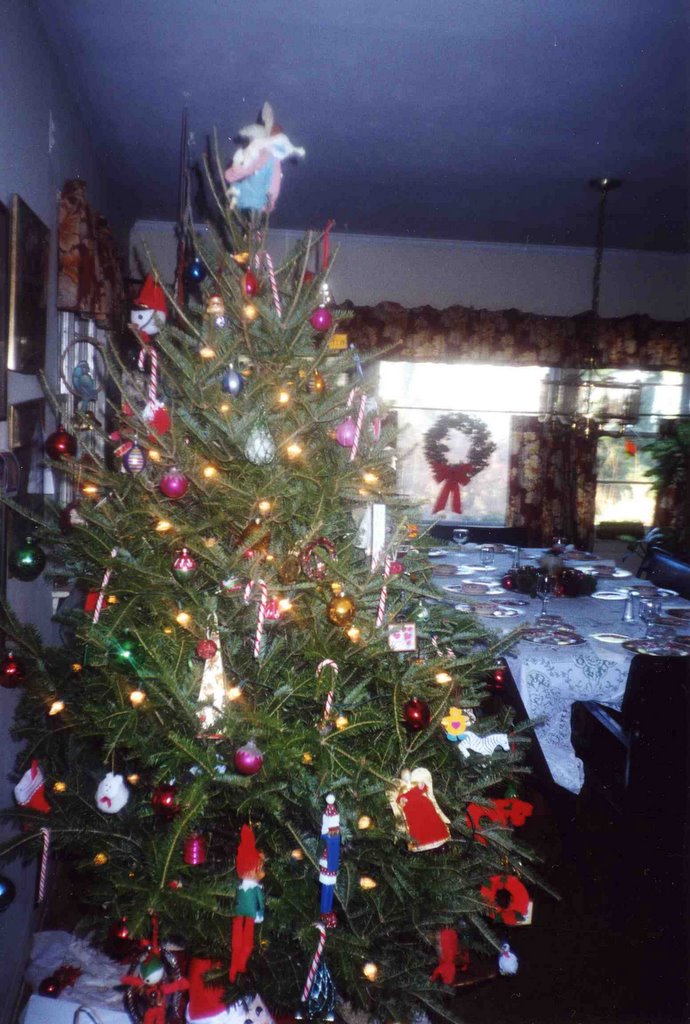 My daughter the writer wrote this description of a family Christmas Eve as part of a college application essay.
We’re in the midst of our annual Christmas Eve tree-trimming bash at my grandmother’s house. My father and my uncle Gerry are bringing in the tree, and my sisters and I are breathlessly awaiting its unveiling. I’m afraid that the reason is not that we’re waiting for this magical season to weave its spell over us. We get as sentimental as anyone over Christmas, but right now we’re wondering what geometric figure the tree will most closely resemble. My grandmother is very frugal. The result of this is that her trees are always cheap, but they also tend to have rather original shapes.
They bring the tree through the door, set it in the stand, and cut the netting around it. It does not disappoint. It’s, it’s...it’s nearly a perfect cylinder! My sisters and I begin hanging the ornaments. They consist of a few beautiful heirlooms, some traditional Christmas balls, many, many plastic multi-colored plastic disco balls, and a good number of styrofoam-and-yarn-elves which have been mysteriously decapitated over the years.
The traditional meal of tortilla chips and salsa is served. Much to everyone’s chagrin, but to no one’s surprise, Grandma has frozen the salsa. She has a rather touching faith that the best thing to do for any, and I do mean any, food is to stick it in the freezer for six months. Fortunately, the chips escaped unscathed.
My father places the angel on top of the tree, and we step back and admire our handiwork. It’s may not be one of man’s great artistic endeavors, but this tree has character, lots of character.
Subscribe to:
Posts (Atom)